

Stages of competence framework
👇 Get new sketches each week
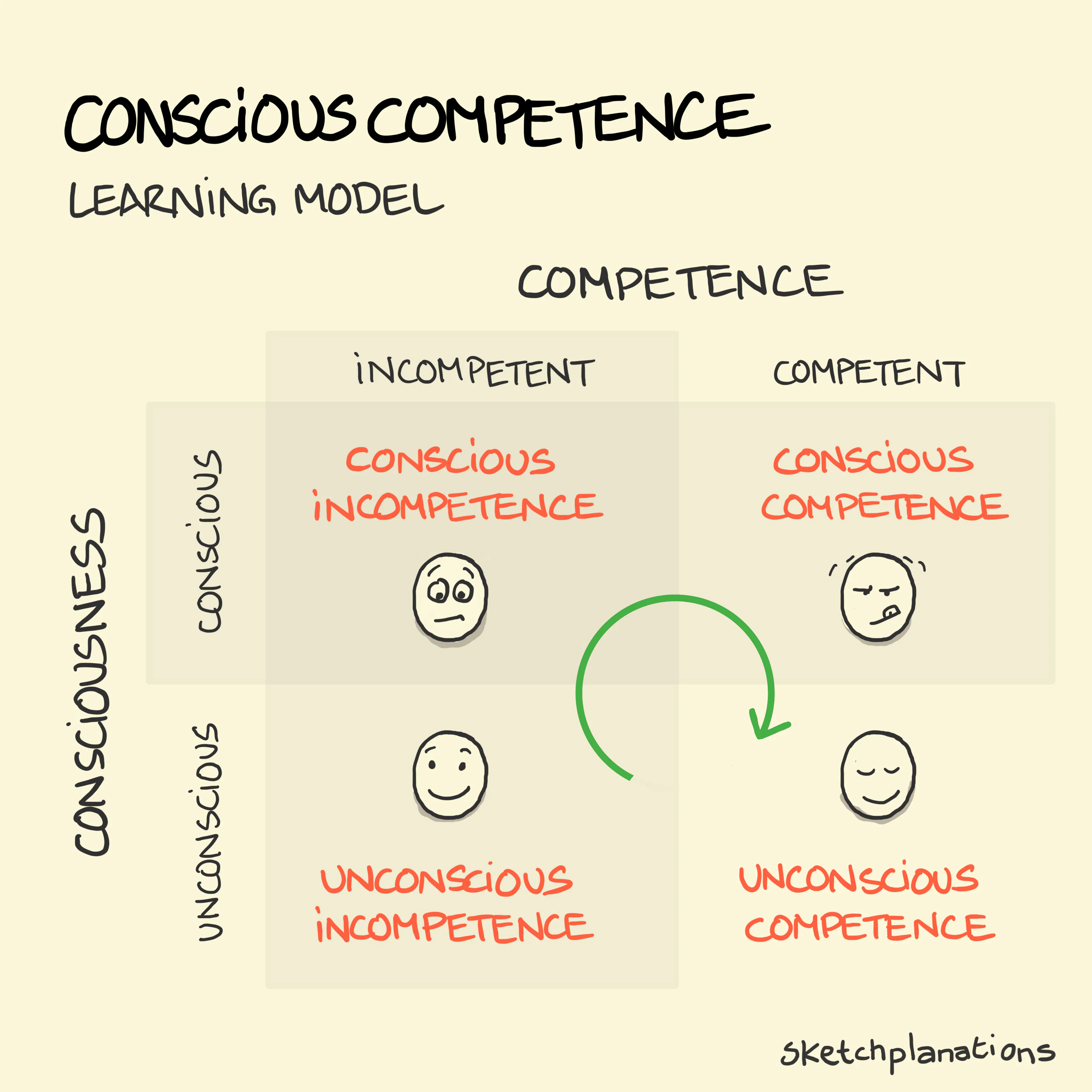
The conscious competence learning model is handy to have in mind when you are learning or teaching a skill.
We are rarely competent at any new skill at first. If we continue working at it, it's common to eventually have revealed to us just how much we don't know. For example, having learned to swim when I was young, I always considered myself capable. Only much later, when taking a stroke technique class, I realized how much I still had to learn. I've come to regard realizations such as these—a shift to conscious incompetence—as a happy achievement.
With effort, time, and a good teacher, we may achieve conscious competence—performing the skill with conscious effort. Only later, after sufficient practice for a skill to become automatic, may we achieve unconscious competence—effortlessly performing the skill without consciously thinking about it.
For great teachers, I learned that a final step takes you back to conscious competence. In this stage, you are not just excellent at the skill but also aware of what you do that makes you excellent. This knowledge enables teaching a skill to others and is what, for example, helps make a great tennis player also a great coach.
I updated the original of this sketch for my book Big Ideas Little Pictures
Related Ideas to the Conscious Competence Learning Model
Also see:
- Wooden's 8 Laws of Learning
- The Upward Spiral
- Try new things
- I will study and get ready
- The Express-Test Cycle
- The third teacher
- Autonomy, Mastery, Purpose
- Goldilocks Tasks
- The Learning Pit